
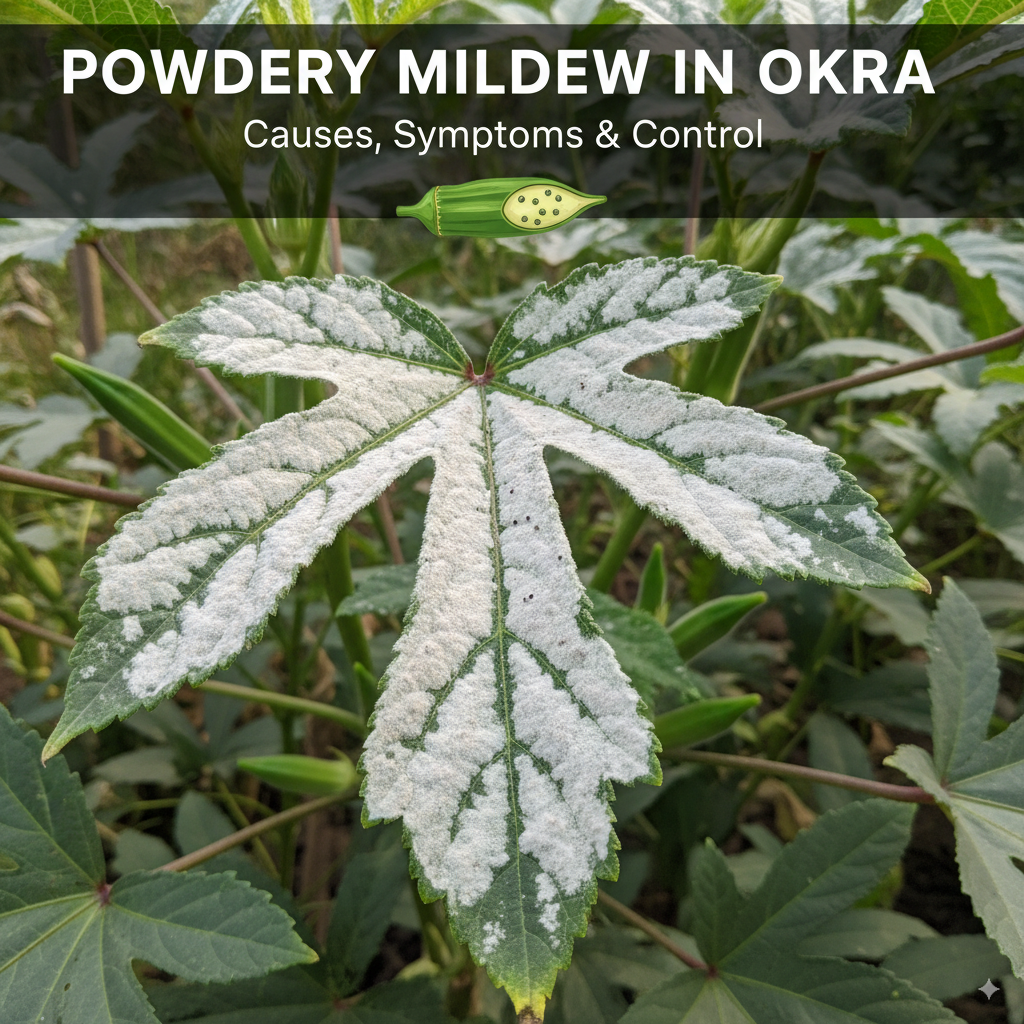
Okra (Abelmoschus esculentus), one of the most widely grown vegetables in tropical and subtropical regions, is highly valued for its nutritional and economic importance. However, it is also prone to a range of diseases that can drastically reduce yield and quality.
Among these, Powdery Mildew is recognized as a disease of national significance in India and other okra-growing regions. Left unmanaged, it can cause severe defoliation and yield loss.
This article is based on the Agro-Ecosystem Analysis (AESA) based Integrated Pest Management (IPM) package developed by the National Institute of Plant Health Management (NIPHM). It outlines the causal organism, characteristic symptoms, and a holistic management strategy that prioritizes sustainability and reduces dependency on chemical pesticides.
Causal Organism
- The disease is caused by the fungus Erysiphe cichoracearum DC.
- Primary survival structures: dormant mycelium and cleistothecia (in crop residues).
- Secondary spread: wind-dispersed conidia (asexual spores).
- Key implication: Field sanitation and canopy management are critical for disease control.
Symptoms of Powdery Mildew in Okra
Early detection is crucial. Typical signs include:
- Grayish-white powdery coating (flour-like) on both upper and lower leaf surfaces.
- Yellowing of leaves as the infection progresses, reducing photosynthesis.
- Premature leaf drop, leading to weakened plants and significant yield losses.
📌 Visual identification and timely intervention are essential in AESA-based IPM.
Integrated Management (AESA-Based IPM Approach)
The AESA-based IPM framework emphasizes field observation, farmer participation, and ecological balance. Instead of relying solely on pesticides, it integrates cultural, biological, and (when necessary) chemical measures.
1. Cultural Practices
- Maintain proper plant spacing to reduce humidity in the crop canopy.
- Rotate with non-host crops; avoid continuous okra cultivation.
- Apply balanced nutrition (avoid excessive nitrogen that makes crops more susceptible).
- Ensure field sanitation by removing infected plant debris.
2. Ecological Engineering for Natural Pest Control
- Grow flowering plants (marigold, sunflower, buckwheat, mustard) along field borders to attract beneficial insects.
- Preserve nectar-rich weeds like Tridax procumbens and Ageratum sp. that support natural enemies.
- Add organic amendments (FYM, vermicompost, crop residues) to enhance soil biodiversity.
- Apply Trichoderma and Pseudomonas fluorescens as seed or soil treatments to suppress pathogens.
3. Biological Control
- Spray neem-based formulations (Azadirachtin 0.03% EC, 800–1000 ml in 200 L water per acre).
- Prefer bio-pesticides before synthetic options.
4. Chemical Control (Last Resort)
When disease pressure is high and biological options are insufficient:
- Sulphur 80% WP: 1252 g in 300–400 L water/acre.
- Dinocap 48% EC: 90 ml in 300 L water/acre.
⚠️ Safety Note: Always follow recommended dosages, wear protective gear, and avoid spraying during hot afternoons, strong winds, or rainy conditions. Adhere to waiting periods before harvest to minimize residue risk.
Why AESA-Based IPM Works
Unlike conventional ETL (Economic Threshold Level) methods, AESA emphasizes:
- Pest: Defender Ratio (P\:D ratio) — If natural enemies outnumber pests (2:1 or more), chemical intervention is unnecessary.
- Group-based farmer decision making — Farmers observe 20 random plants/acre, discuss findings, and adopt a collective management plan.
- Sustainability first — Chemicals are considered only as a last resort.
Key Takeaways
- Powdery Mildew is a major fungal disease of okra that spreads quickly under favorable conditions.
- Integrated management (cultural, biological, ecological) is the most sustainable approach.
- Farmers should adopt AESA-based IPM to reduce dependence on pesticides, conserve beneficial insects, and protect soil and crop health.
Frequently Asked Questions
What causes Powdery Mildew in Okra?
Powdery Mildew in okra is primarily caused by the fungus Erysiphe cichoracearum. The pathogen survives in crop residues as dormant mycelium and cleistothecia, and spreads mainly through wind-dispersed conidia
What are the symptoms of Powdery Mildew in Okra?
The main symptoms include grayish-white powdery patches on both leaf surfaces, yellowing of leaves, and premature defoliation. Severe infections can significantly reduce photosynthesis and crop yield
How can Powdery Mildew in Okra be managed?
Powdery Mildew in okra can be managed through AESA-based IPM strategies, which combine cultural practices (field sanitation, proper spacing, crop rotation), ecological engineering (flowering plants to attract natural enemies, organic amendments), biological control (neem-based sprays, Trichoderma, Pseudomonas fluorescens), and, when necessary, chemical fungicides like Sulphur WP and Dinocap EC.
When should chemical fungicides be used for Powdery Mildew in Okra?
Chemical fungicides should be used only as a last resort when cultural and biological measures fail and the pest: defender ratio is unfavorable. Recommended fungicides include Sulphur 80% WP and Dinocap 48% EC, applied with proper safety precautions